

Anyone who has crawled down the Dan Ryan in a January snow squall knows that traction is not a luxury in Chicagoland. When you start shopping for a new Chevrolet, though, two similar-sounding terms come up fast: all-wheel drive and four-wheel drive. Both send power to all four wheels, but they work differently, and choosing the wrong one can mean paying for capability you never use or missing capability you really need.
What Is the Difference Between AWD and 4WD?
All-wheel drive (AWD) is an automatic system that sends power to the wheels with the most grip, with nothing for the driver to switch on. Four-wheel drive (4WD) is a driver-selected system, built around a transfer case, that locks the front and rear axles together for maximum traction in deep snow, mud, or heavy-duty work. In short, AWD decides for you, while 4WD waits for your command.
How All-Wheel Drive Works
Think of AWD as a safety net that is always on. Sensors monitor wheel speed and road conditions, and the system shifts power between the front and rear axles the moment one set of tires starts to slip. You never press a button or think about it.
That makes AWD a natural fit for everyday driving. It helps you pull away from a slick intersection, hold your line on a rain-soaked expressway, and stay confident on the commute into Chicago when the forecast changes halfway through your drive. Chevrolet offers AWD on popular crossovers and SUVs like the Equinox and Traverse, which is why so many families around Tinley Park and the south suburbs choose them for school runs and weekend errands.
How Four-Wheel Drive Works
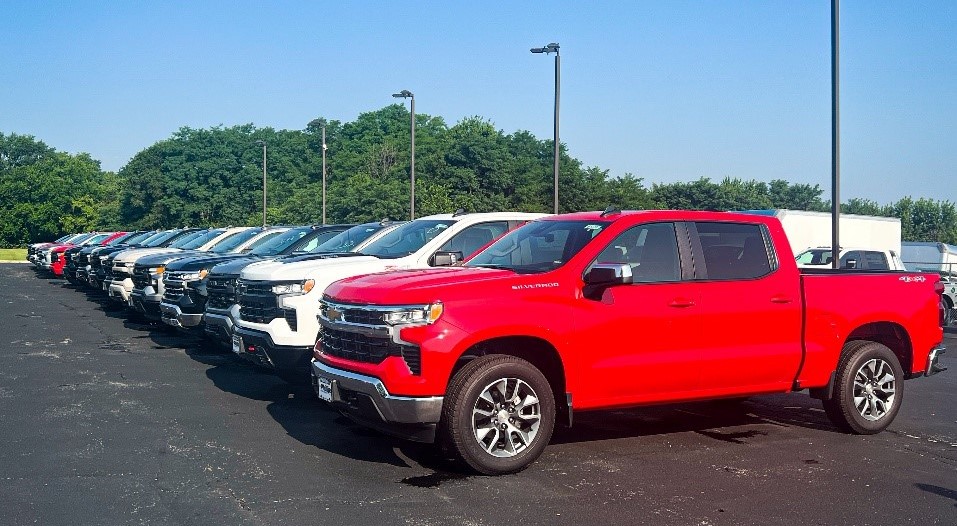
Four-wheel drive is the heavy-duty option, and you will find it on trucks and large SUVs such as the Silverado 1500 and Tahoe. Most systems let you choose between two-wheel drive for dry pavement, 4HI for slippery roads, and 4LO for low-speed, high-torque situations like pulling out of a snowbank or climbing a muddy grade.
Because 4WD locks the axles together, it is meant for low-traction surfaces rather than dry roads. Used correctly, it gives a truck the pulling power that AWD systems are not designed to match. That matters if you tow a trailer, plow a driveway, or head out to a job site before the crews have cleared the roads. A contractor in La Grange or a homeowner with a long gravel drive near New Lenox will feel that difference quickly.
Which One Fits Your Driving?
Start with how you actually use your vehicle, not with the spec sheet.
Choose AWD if most of your miles are commuting, errands, and road trips, and you want steady, automatic grip in rain, light snow, and slush without thinking about it. It is the easier, more car-like experience.
Choose 4WD if you tow, haul, work outdoors, drive unpaved roads, or regularly face deep or unplowed snow. It gives you control over how much traction you call on and the durability that serious work demands.
Plenty of Silverado owners in the south suburbs use 4WD only a handful of days each winter, but they say having it ready when a storm hits is worth every penny. If that sounds like you, 4WD is peace of mind you only pay for once.
Don’t Overlook Your Tires
Here is the part many shoppers miss: AWD and 4WD help you get moving and keep moving, but neither one helps you stop any faster. Your tires do that work. A quality set of all-season or winter tires makes a bigger difference to real-world safety than the drivetrain alone, so budget for good rubber whichever system you choose.
Ready to Find the Right Drivetrain?
The best way to understand the difference is to feel it. If you want a truck that can handle a snowy Tinley Park morning, a job site, and a weekend towing trip with equal ease, a four-wheel drive Silverado deserves a look. Browse our Silverado inventory online or stop by Phillips Chevrolet in Frankfort, and our team will help you compare configurations, take a test drive, and find the drivetrain that fits the way you live and work.
When you visit Phillips Chevrolet, with locations in Frankfort, Lansing, and Bradley, you’re visiting the best in the business. Family-owned and operated for over 50 years, we don't just sell cars; we build relationships. Our commitment to excellence has earned us the title of Cars.com 'Chevrolet Dealer of the Year, ' ranking #1 in the United States among over 3,000 Chevy dealerships, and recognition as the #1 Selling Chevy Dealer in Illinois for 20 years in a row. We are also a JD Power 'Dealer of Excellence' and proudly maintain an A+ Rating with the Better Business Bureau. With Illinois’ largest Chevrolet inventory and a team dedicated to award-winning service, we’re ready to help you find your next dream car.
FAQ: AWD vs. 4WD
Q: Is AWD or 4WD better in snow?
A: Both handle Chicago winters well. AWD is better for automatic, everyday grip on plowed and partly covered roads, while 4WD is better for deep snow, unplowed streets, and towing.
Q: Can I use 4WD on dry pavement?
A: Generally, no. Part-time 4WD systems lock the axles together, which can cause binding and wear on dry roads. Use it on snow, ice, mud, or gravel, and switch back to two-wheel drive afterward.
Q: Does AWD use more fuel than two-wheel drive?
A: Typically, a little, because the system adds weight and moving parts. Many drivers find the added traction well worth the small difference.
Q: Is the Chevy Silverado available with 4WD?
A: Yes. The Silverado 1500 is offered with four-wheel drive, so you can match the truck to your winter driving and work needs.
Q: Do I need AWD or 4WD if I mostly stay on the highway?
A: Not necessarily, but Chicago weather can turn quickly. Many commuters choose AWD for the added confidence in rain and snow.