

Start with Your Heaviest Regular Day, Not Your Average One
Most buyers shop for the typical week. The smarter move is to shop for the heaviest day you hit more than a few times a year. A landscaper with a loaded dump trailer, a contractor hauling a skid steer, and a farmer moving livestock trailers all live near the top of the weight range, even if most days are lighter.
Write down three numbers: the loaded weight of your trailer, the weight of everything in the bed and cab, and the tongue or pin weight pushing down on the hitch. Then compare them with the ratings on the exact truck you are considering. Ratings vary by cab, bed, drivetrain, and engine, so the door-jamb sticker matters more than any headline number.
Where the 2500 HD Makes Sense
The 2500 HD is the right-sized answer for a lot of working owners. It tows serious weight, handles plow-and-salt-spreader duty, and carries a full-size toolbox plus a crew’s gear without strain. It also rides a little more comfortably empty, which counts if the truck doubles as your commuter.
That matters for anyone driving the Stevenson or the Dan Ryan into Chicago each morning, where a stiff, empty truck rattles over expansion joints and potholes. A 2500 HD with the right suspension and tire choices usually feels more livable on those commutes. It is also easier to place in a parking structure or a tight La Grange side street, since a single-rear-wheel truck is narrower than a dually.
Where the 3500 HD Earns Its Keep
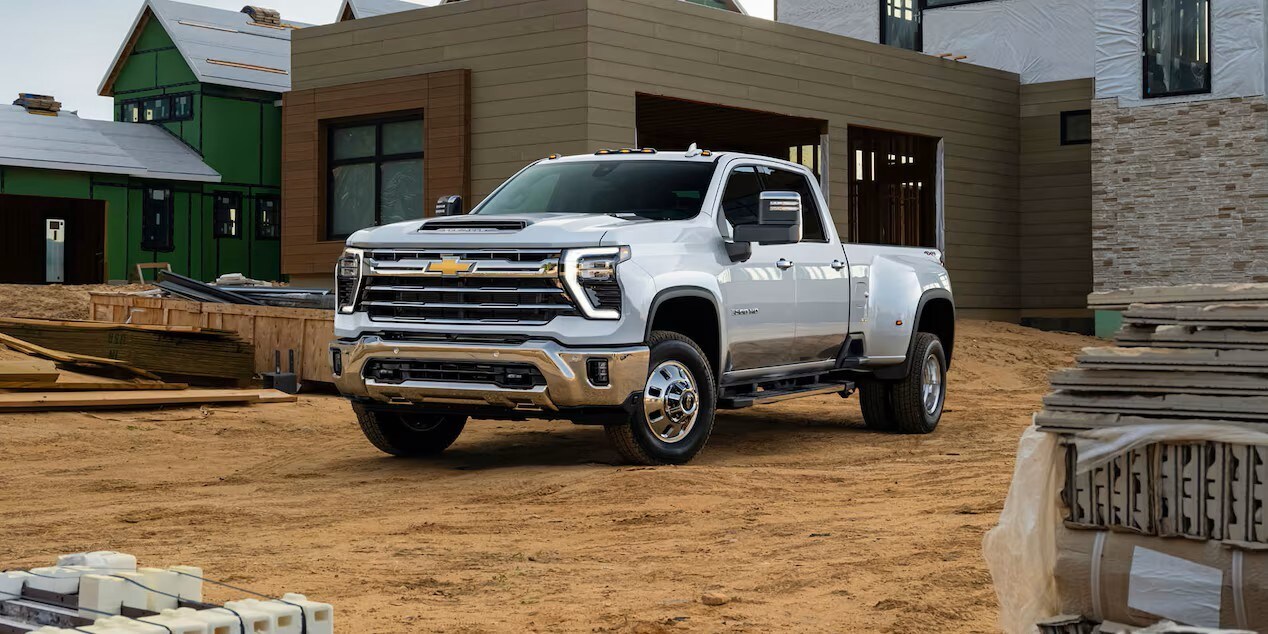
The 3500 HD is built for the heaviest tasks. It offers higher payload and towing capacity, and with dual rear wheels it can pull large gooseneck and fifth-wheel trailers that a 2500 HD should not. If you haul equipment haulers, car trailers, or a big camper, the extra margin is a real safety and durability advantage, not a luxury.
A dually has tradeoffs. It is wider, it takes more care in tight lots, and it costs more to buy and maintain. A contractor running between job sites in Tinley Park and New Lenox may love the stability under a heavy load but find the width a hassle in older neighborhoods with narrow driveways. Ask yourself whether you would use the extra capacity every week or only once or twice a year.
Gas or Duramax Diesel
Both trucks offer the 6.6L gas V8 and the 6.6L Duramax turbo-diesel with an Allison 10-speed automatic. Gas costs less up front and suits owners who tow occasionally or drive mostly short routes. The Duramax delivers far more torque, stronger exhaust braking, and more confidence on long, heavy hauls. If your truck mostly handles stop-and-go traffic and short trips, a diesel may not pay back its premium. If you tow heavy loads for miles, it usually does.
Midwest Conditions Change the Math
Chicagoland driving is hard on trucks. Salt-heavy winters, freeze-thaw potholes, and stop-and-go expressway traffic reward a truck with margin to spare. Hauling near the limit on a snowy day on I-80 feels different from hauling near the limit on a dry July afternoon, and a bigger buffer pays off when the weather turns. Four-wheel drive is worth serious consideration for anyone who works through winter.
If you tow with a business plate, also consider your insurance, weight-class paperwork, and whether your loaded combination crosses a threshold that changes your licensing or inspection requirements. A quick conversation with a commercial specialist now saves a headache later.
A Simple Way to Decide
If your loaded combination stays comfortably under the 2500 HD’s ratings, buy the 2500 HD and enjoy the better everyday ride and lower cost. If you are near its limits more than occasionally, or you plan to grow into heavier work, buy the 3500 HD. Trucks usually stay in service for many years, so give yourself room for where the business is heading.
Ready to Compare Them in Person?
Numbers only go so far. The best way to decide is to see both trucks, climb in, and match them to your real loads. Stop by Phillips Chevrolet in Frankfort, browse our Silverado HD inventory, and talk through your work with a team that will help you size the truck correctly. Shop a Chevrolet Silverado at Phillips Chevrolet today.
When you visit Phillips Chevrolet, with locations in Frankfort, Lansing, and Bradley, you’re visiting the best in the business. Family-owned and operated for over 50 years, we don't just sell cars; we build relationships. Our commitment to excellence has earned us the title of Cars.com 'Chevrolet Dealer of the Year, ' ranking #1 in the United States among over 3,000 Chevy dealerships, and recognition as the #1 Selling Chevy Dealer in Illinois for 20 years in a row. We are also a JD Power 'Dealer of Excellence' and proudly maintain an A+ Rating with the Better Business Bureau. With Illinois’ largest Chevrolet inventory and a team dedicated to award-winning service, we’re ready to help you find your next dream car.
FAQ: Silverado 2500 HD vs. 3500 HD
Q: What is the main difference between the Silverado 2500 HD and 3500 HD?
A: The 3500 HD is rated for higher payload and towing, and it is the only one offered with dual rear wheels. The 2500 HD is lighter, more maneuverable, and typically rides better when unloaded.
Q: Can a 2500 HD tow a fifth-wheel or gooseneck trailer?
A: Yes, within its ratings. If your trailer’s pin weight and total weight approach or exceed those ratings, the 3500 HD is the safer choice.
Q: Is the Duramax diesel worth it?
A: It is for owners who tow heavy loads regularly or cover long distances. For mostly local, lighter work, the gas V8 often makes more financial sense.
Q: Which is better for daily driving around Chicago and the suburbs?
A: The 2500 HD is usually easier to live with because it is narrower and rides more smoothly when empty. A dually 3500 HD is best saved for owners who truly need the capacity.
Q: How do I confirm a truck’s exact capacity?
A: Check the door-jamb label and the build sheet for that specific truck, since ratings change by configuration. Our team can walk you through both.